


When word spread last year that Canadian Liam Draxl had carved up the tournament’s mini golf course with seven holes-in-one in a single round, course architect Joe Johnson got a call.
On the court, players at the Rolex Shanghai Masters expect only the toughest world-class competition. It stands to reason that the 18-hole mini golf course, which hosts the popular Putt Masters, should present a similar challenge.
Cue a directive from Charles Smith, Managing Director of the Rolex Shanghai Masters, with a clear message to Johnson: Make the course bigger, better, tougher.
The result? This year, the Putt Masters is playing more like Carnoustie than Pirates Cove in Orlando. And the players love it.
“The conditions have gotten a lot tougher,” Draxl said with a smile, knowing that his record now will likely stand the test of time. “Definitely this year it benefits the more solid two-putter. Every hole-in-one is that much more valuable now. And those three-putts around here really hurt the scorecard.”
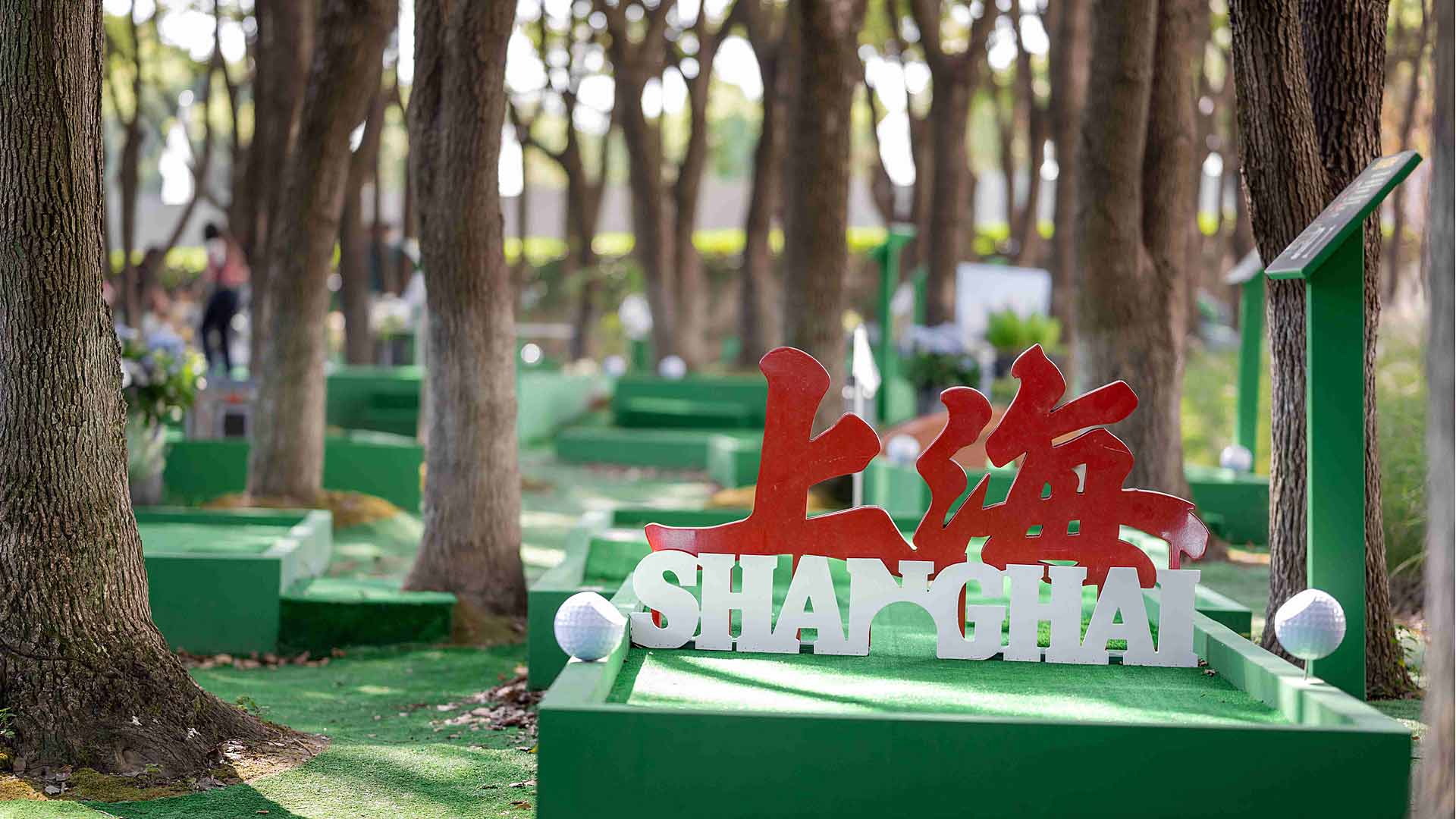
Located just steps outside the players’ restaurant, the course is a hit with ATP Tour stars and their support teams. More than 1000 rounds were played last year.
All holes have their own Chinese theme, including tributes to the Great Wall, Three Gorges Dam (which includes a working water feature), The Bund, Xi’an warriors and, of course, pandas. The 18th hole has a spectacular model of the stadium court’s famed magnolia roof and signposts to the other eight ATP Masters 1000s, including references to their distance from Shanghai.
“Like all tournaments, we’re trying to understand the best use of players’ time when they’re not in the gym, not practising, not eating,” Smith said. “All these guys play golf and we have this amazing space right by the restaurant and the gym. The location is critical because everybody sees other people playing and it becomes a real, fun competition.
“It’s great for team equilibrium. Normally the player is the focus within the team. When they’re playing the Putt Masters they’re no longer the boss. The dynamic completely changes in a fun way.”
Because the course winds its way through protected trees and vegetation, nothing can be removed or damaged and holes cannot be dug into the site. Johnson designs the course around the existing forest, working with the same highly skilled construction team responsible for infrastructure elsewhere at the tournament.
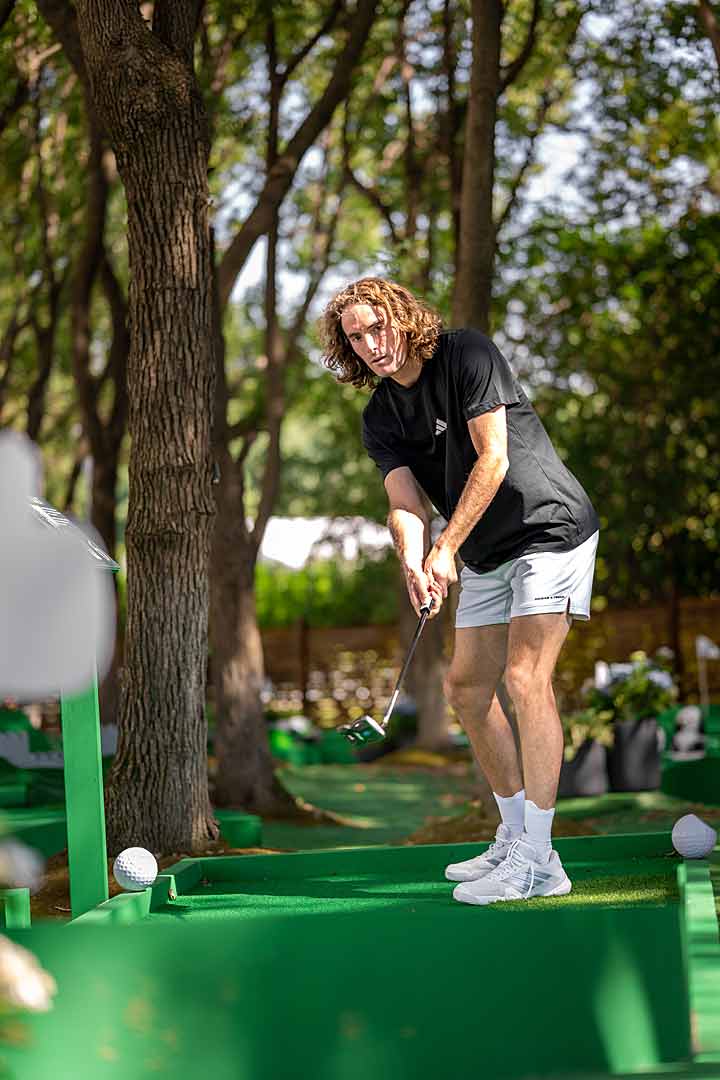
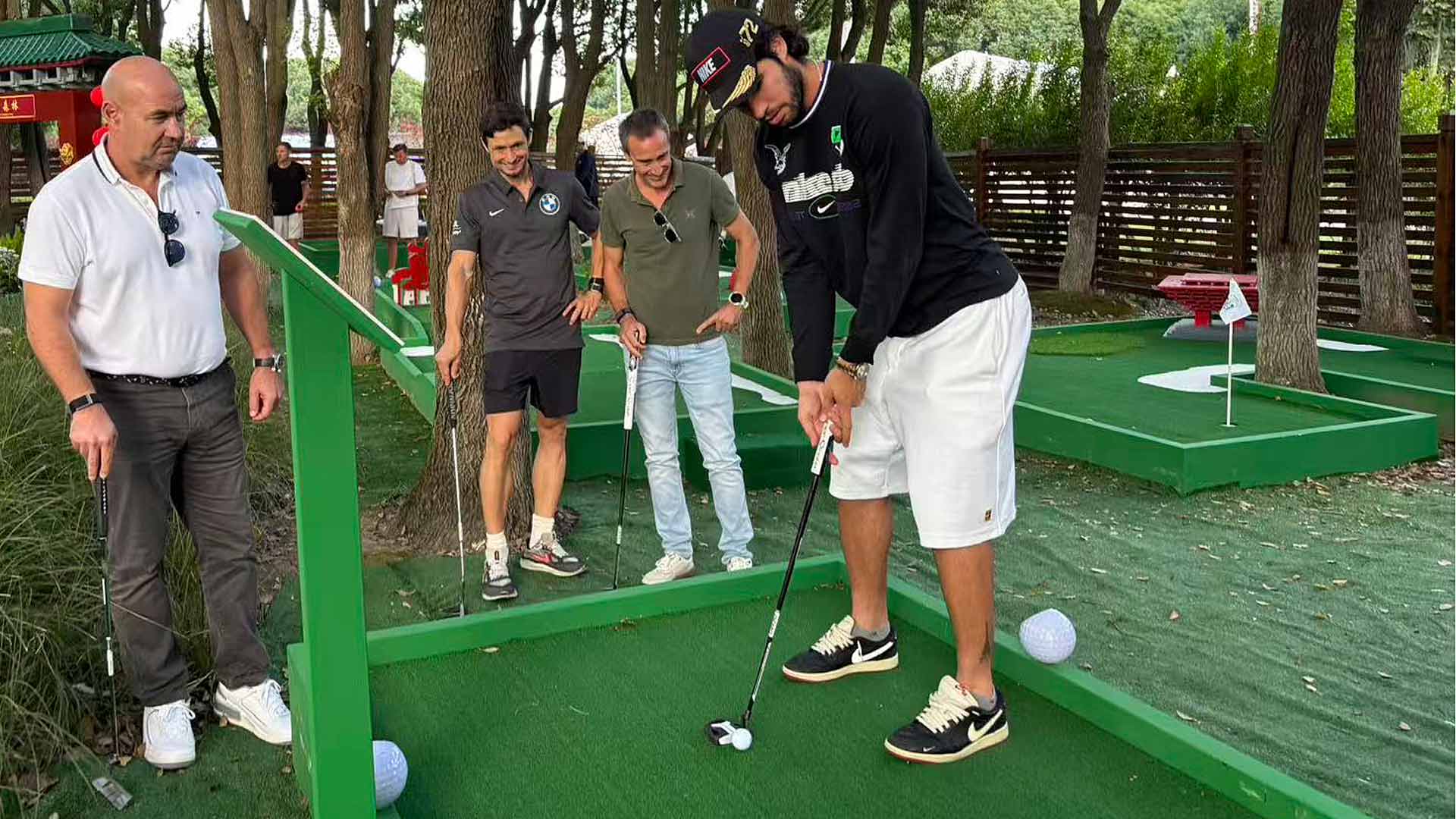
Stefanos Tsitsipas tries his luck at the Putt Masters.
This year he deliberately incorporated trees into some putting surfaces rather than simply designing around them, adding another strategic element to the course.
“Fortunately for me, the crew that builds these frameworks is the same crew that builds everything in the stadium. And they are better than perfect,” said Johnson, who designs the holes from his home in Florida.
“You can’t dig any holes. You can’t make any kind of damage to the forest or the plants.
“I do kind of elaborate drawings. I don’t do as many measurements because I don’t have a record of where the trees actually are. So they can take the plan and go, ‘Oh, if we skew this just a little bit, we can fit this right here’.”
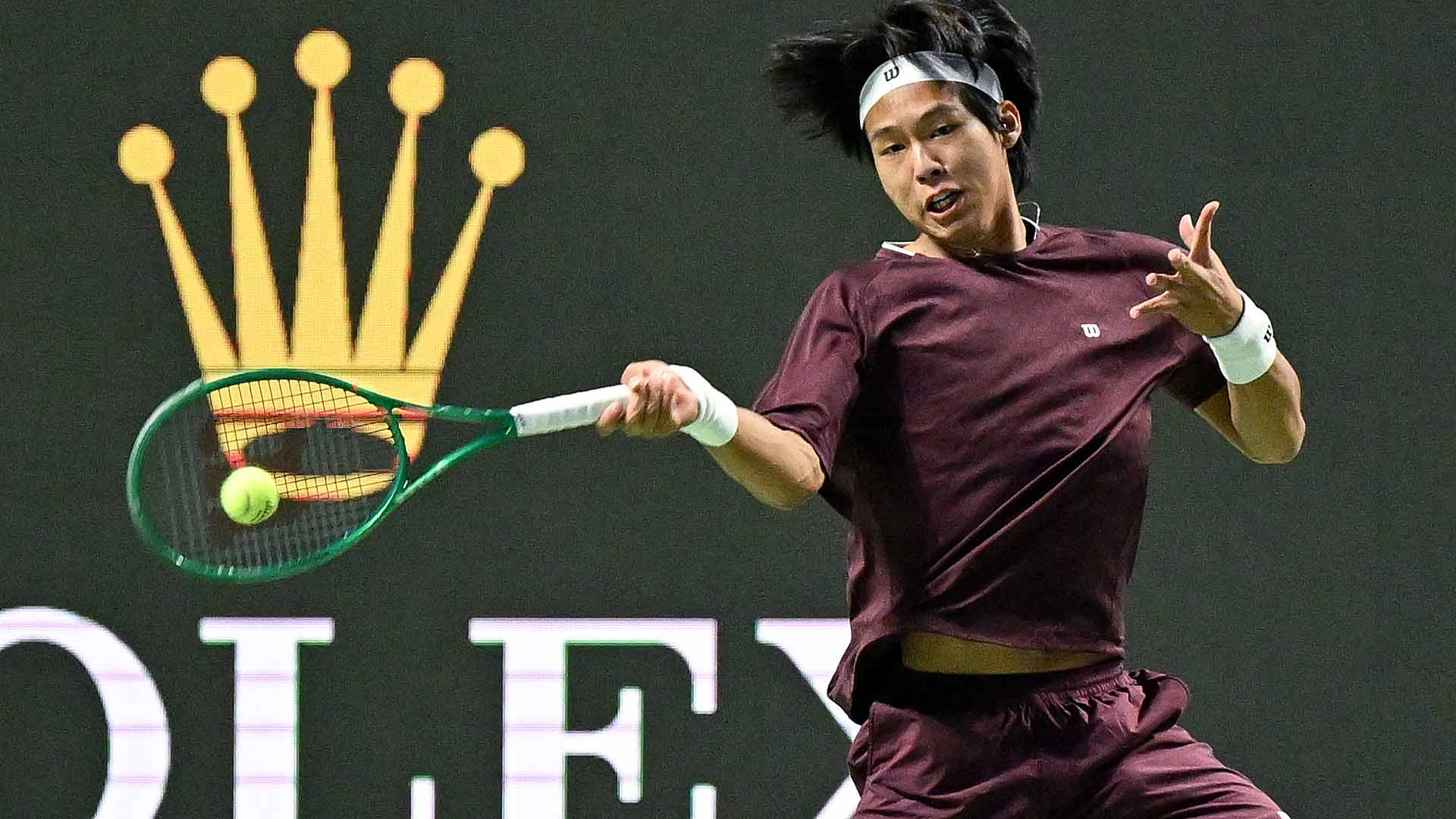
Australian Rinky Hijikata, who won the competition two years ago, likes the course upgrade.
“It’s 18 holes now; it was nine holes the year I won it,” he said. “They do an unbelievable job here. They had the F1 simulator, the Putt Masters, and a new driving competition this year.
“It definitely makes it a lot more enjoyable when you’re on site and easy to kill time here.”
Players also had the chance in the first week to swap putters for drivers as part of a TaylorMade driving challenge. TaylorMade’s technical shot-distance meter recorded five drives beyond 320 yards, including a winning 354-yard blast from Argentine World No. 204 singles player Federico Gomez, whose swing speed was measured as 131 mph.

Casper Ruud unleashes at the TaylorMade long drive competition.
Back at the Putt Masters, two competitions are held: one for players and one for player support team members.
Former Top 40 player Christian Ruud, who coaches his son Casper, said, “It’s good to have some activities for the players and the teams. We love golf, so to have mini golf is perfect for us. They make it very easy for us here in Shanghai.
“It’s a cool course. You have some chances to do some holes-in-one, but also some holes where you can get a five or six.”
Ruud was the clubhouse leader in the early days of this year’s support-team competition with a 36 but returned the following day to see his lead had been usurped by Ken Skupski’s blistering round of 33. “I’ll try again for sure, but I think that’s going to be tough to beat.”
Eduard Esteve Lobato later shot a 33 to tie Skupski on the Player Support Team leaderboard, but Skupski won the playoff and carried off the TaylorMade clubs.
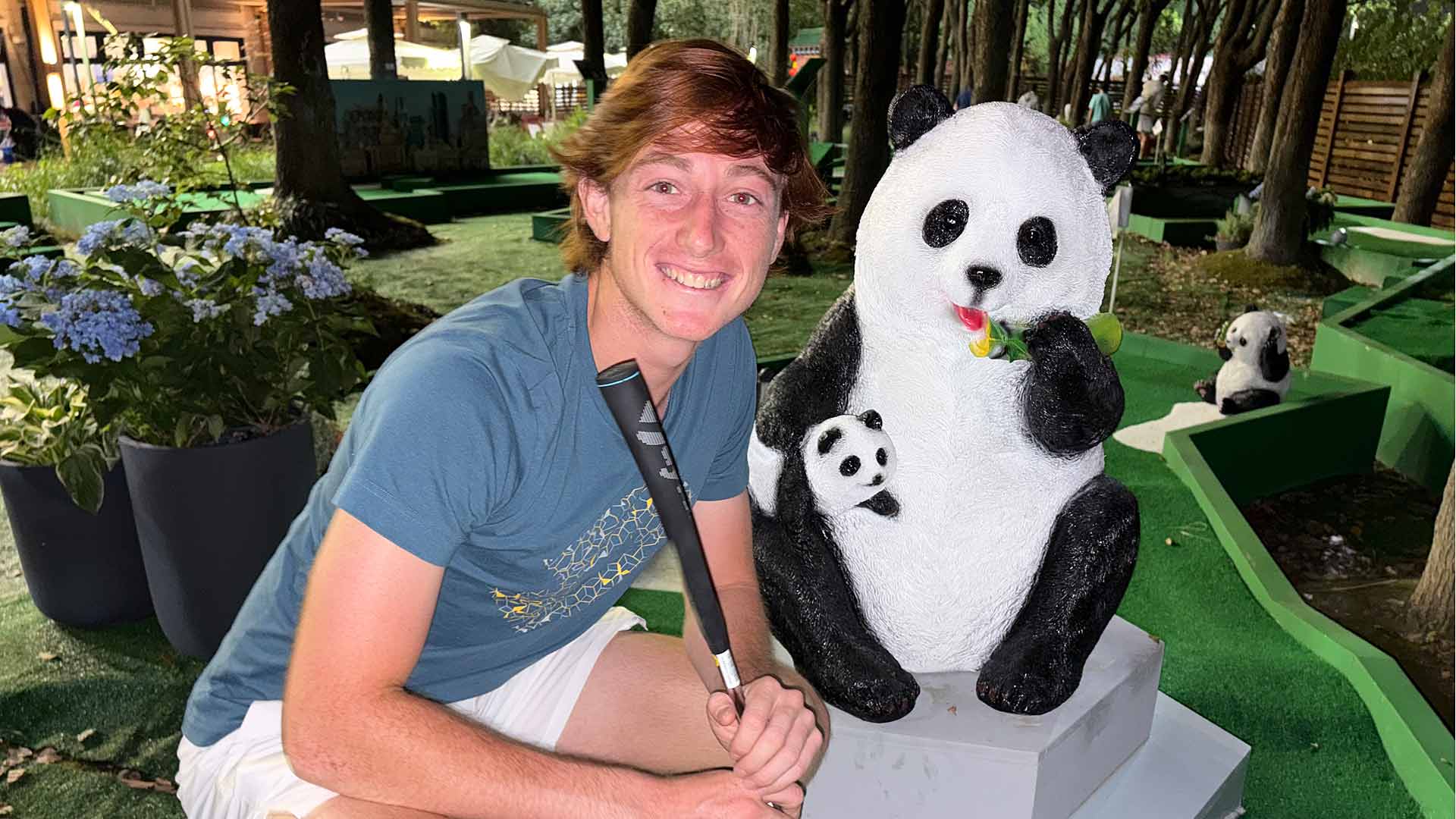
Putt Masters champion Ignacio Buse on his favourite hole, 'Panda'.
Peru’s World No. 36 Ignacio Buse emerged as Putt Masters champion among players with a winning round of 32, leapfrogging Casper Ruud and Pablo Carreno Busta with back-to-back holes-in-one on the 17th and 18th holes (witnessed and verified by tournament concierge Jasper Thomas).
“Coming into the final two holes I didn’t think I had a chance to win, so I wasn’t feeling any pressure,” said Buse, who earned a TaylorMade club set for his efforts. “But the last two holes are the easiest to do a hole-in-one. I did that two times but still didn’t notice I had a 32 until I counted it all up.
“The course is unbelievable. It’s so pro, so pro. You have those amazing things. We have the Great Wall, Formula 1, pandas. We call my fitness coach ‘Panda’, so that’s my favourite hole.”
Novak Djokovic, who has won a record four Rolex Shanghai Masters, had not had time to inspect the tougher course before his pre-tournament press conference, but said that he enjoyed his round last year.
“I tried my luck last year. I wasn't Top 10 on that list," he said with a smile. "I know a lot of the players love to play it, and it's fun, it's a great game. It's one of the activities and content that is available for players to amuse themselves also with their off time on site.”
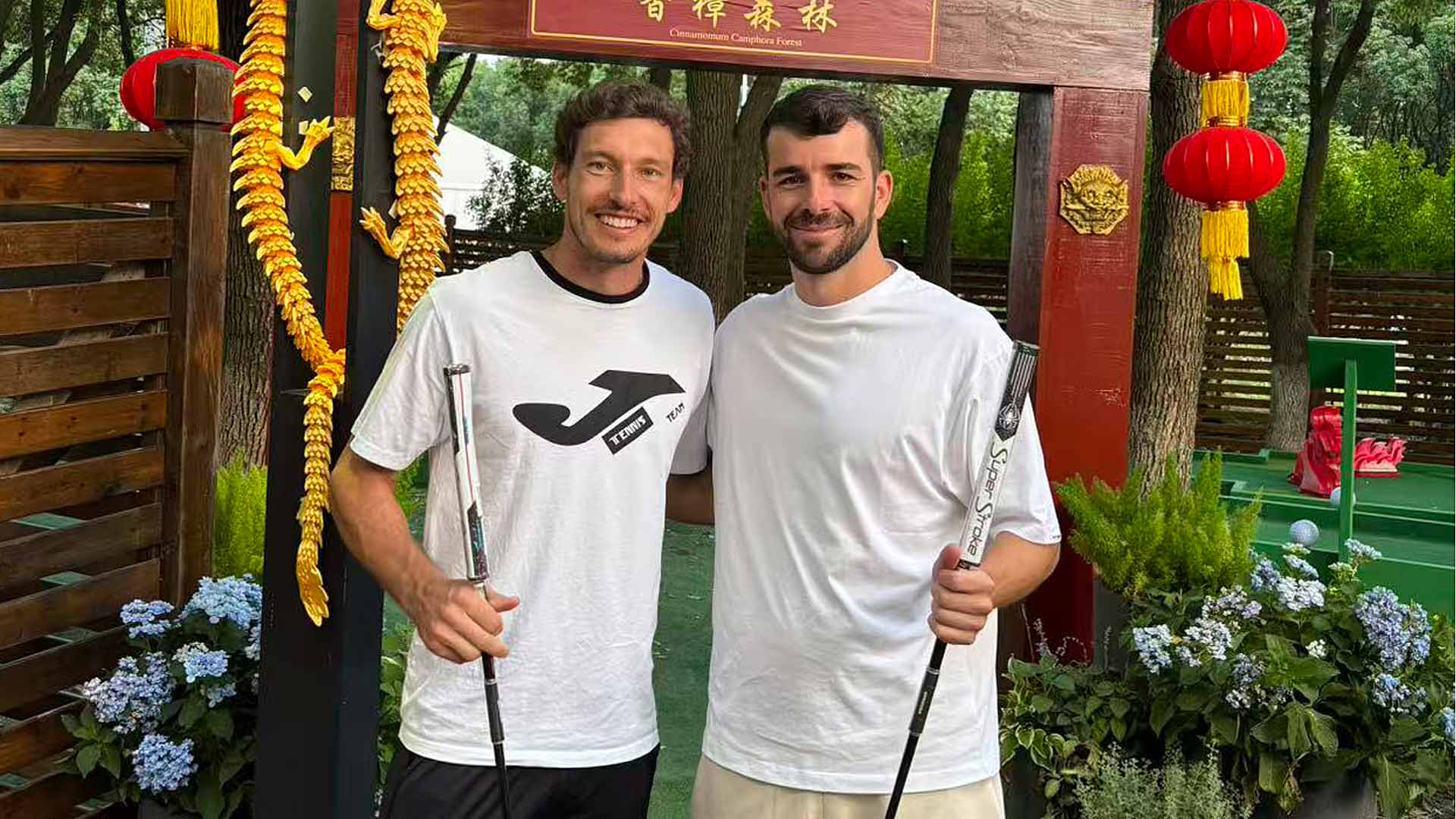
Pablo Carreno Busta and his player support team member Eduard Esteve Lobato finished runner-up in their respective divisions, both earning a TaylorMade Super Stroke putter.
Johnson spent hundreds of hours designing the course from his home near Palm Beach in Florida, imagining a layout designed to make some of the world’s best tennis players think before reaching for the putter. The course gets disassembled at the end of the tournament.
“The major changes were everything is bigger and has more undulations,” Johnson said of this year’s course. “I put foam under the putting surface so that it has some texture and topography.”
Holes four and five, which both run through the Great Wall, are among Johnson’s favourite holes on the course. The Great Wall was sufficiently ambitious that Johnson built an architectural model before construction began. Rather than confining it to one hole, the finished structure traverses two.
“It demanded to have a little more oomph to it than just one hole,” Johnson said.
Johnson spent 31 years as a creative director at Time magazine and has a background in engineering and architecture. He had never designed a miniature golf course before Smith, a friend of more than 30 years, asked him to help add themed elements to Shanghai’s original layout three years ago.
Mounds can take away a direct route to the hole. Doglegs offer choices. Trees can block the view of the cup. And water really does mean water.
Of the 18 holes, 15 are par-2s and only three are par-3s.
“You’ve got to have a little challenge,” Johnson said. “And I think the players appreciate that.”