


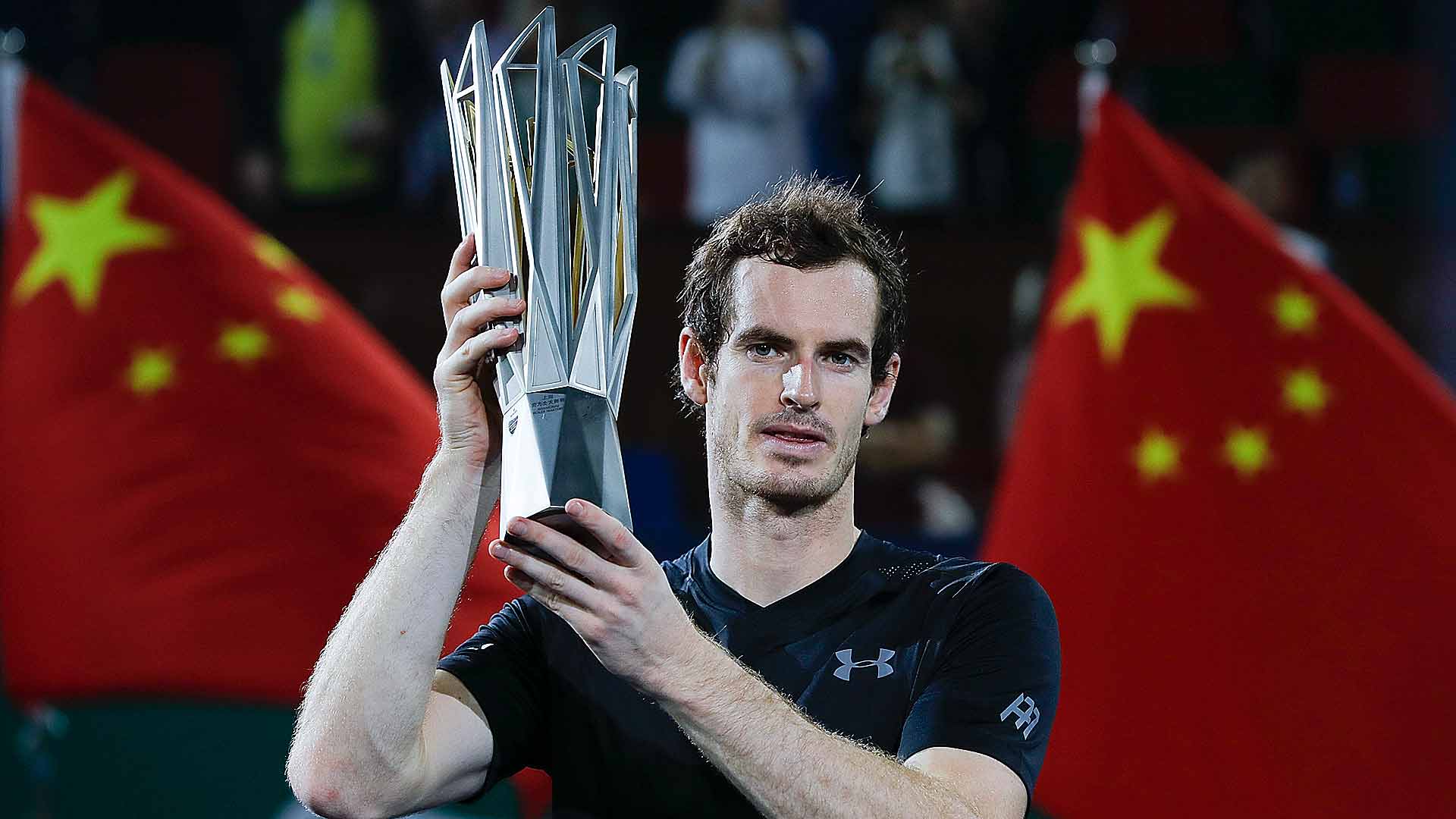
Ten years have passed since Andy Murray lifted his third and final trophy at the Rolex Shanghai Masters.
In isolation, Murray’s utterly dominant title run on his tournament debut six years earlier in 2010 is hard to top. He didn’t drop more than seven games in any of his five victories and blitzed Roger Federer 6-3, 6-2 in the final. And for good measure, he successfully defended the title one year later.
But for impact within a broader context, however, the Scot’s third title in 2016 was the most consequential.
Paired with his victory in Beijing the week before, it marked the early stages of a remarkable winning streak that would have its dramatic finale less than two months later in the final match of the year against friend and rival Novak Djokovic.
Having added the Vienna and Paris titles to his winning streak, Murray faced off against the Serbian in the ATP Finals title match, with the winner guaranteed to finish the year No. 1. Murray closed out his year with his 24th straight win, 6-3, 6-4.
“Winning the title here played a big role in getting him through that year,” said Rolex Shanghai Masters Tournament Director Michael Luevano. “When you think about it, what he did winning 24 straight matches and the final match of the year coming down to year-end World No. 1… it was like a fairytale.
“Andy is one of those guys who was just so comfortable here, winning three times and making another final. In 2016 he was locked in, seeing the ball huge, and just had some dramatic wins. The crowd loves a winner and he was their guy.”
Like 2010, Murray dropped no more than seven games in any match during his 2016 Shanghai title run, defeating Spaniard Roberto Bautista Agut 7-6(1), 6-1 in the final.
Djokovic looked to have a lock on year-end World No. 1 midway through 2016 after winning the Australian Open, Roland Garros and three of the first five ATP Masters 1000s.
But Murray responded by winning Queen’s and Wimbledon, as well as a second Olympic singles gold medal — which carried no ranking points — as he began to narrow the points gap.
Over his career at the Rolex Shanghai Masters, Murray enjoyed a 23-5 record in eight appearances. He won his first 12 matches at Qi Zhong Stadium — including two over Federer — before falling to Djokovic in the 2012 final.